


When Does Perimenopause Really Start?
Medically reviewed by Steve Nunn, MPAS, PA-C, DFAAPA | Tutera Medical
When Does Perimenopause Really Start?
Many women searching for answers ask the same question: when does perimenopause start? The truth is there is no single correct age for perimenopause. Just like how every girl gets their first period at different ages, the perimenopause journey looks different for every woman.
Perimenopause is when a woman’s body begins preparing for menopause. While most women start experiencing perimenopause symptoms in their 40s, it can begin earlier or later for others as well. Menopause officially begins when a woman has not had her period for more than 12 months consecutively. However, the journey leading up to menopause can be long and varies greatly across women.
During this phase, a woman’s ovaries hormones less consistently and estrogen starts to swing unpredictably, which affects her menstrual cycle and general mood and wellbeing. This can look different for every woman. Some women experience more obvious menopause symptoms such as hot flashes and irregular periods, but others experience less obvious symptoms that can feel like random health problems, from acne to UTIs and brain fog.
This can be frustrating for many women, and maybe you’ve had the appointment that so many women describe: you bring up your symptoms, and you’re told you’re too young for this to be perimenopause, your labs are normal, it’s probably stress.
If this sounds relatable, you do not have to figure it out alone. If something feels off, whether it’s your sleep, your mood, your focus, or your cycle, you’re not imagining it and you’re not too young to ask the question.
Why perimenopause symptoms get dismissed
Many women find themselves dismissed at appointments and often told they were just too stressed or anxious and were too young to be in perimenopause. Unfortunately, early perimenopause symptoms can be mistaken for many other things as the earliest signs are often not obvious menopause symptoms such as hot flashes. They are often changes in mood, sleep or brain fog which on paper can look just like anxiety, depression or burnout.
Often, women are also making an appointment with their primary care provider who might not be trained and certified to treat menopause, and since these symptoms can be mistaken for other issues, perimenopause continues to be dismissed. Understanding when perimenopause can start is the first step to getting the right diagnosis.
The early signs of when perimenopause starts that people miss
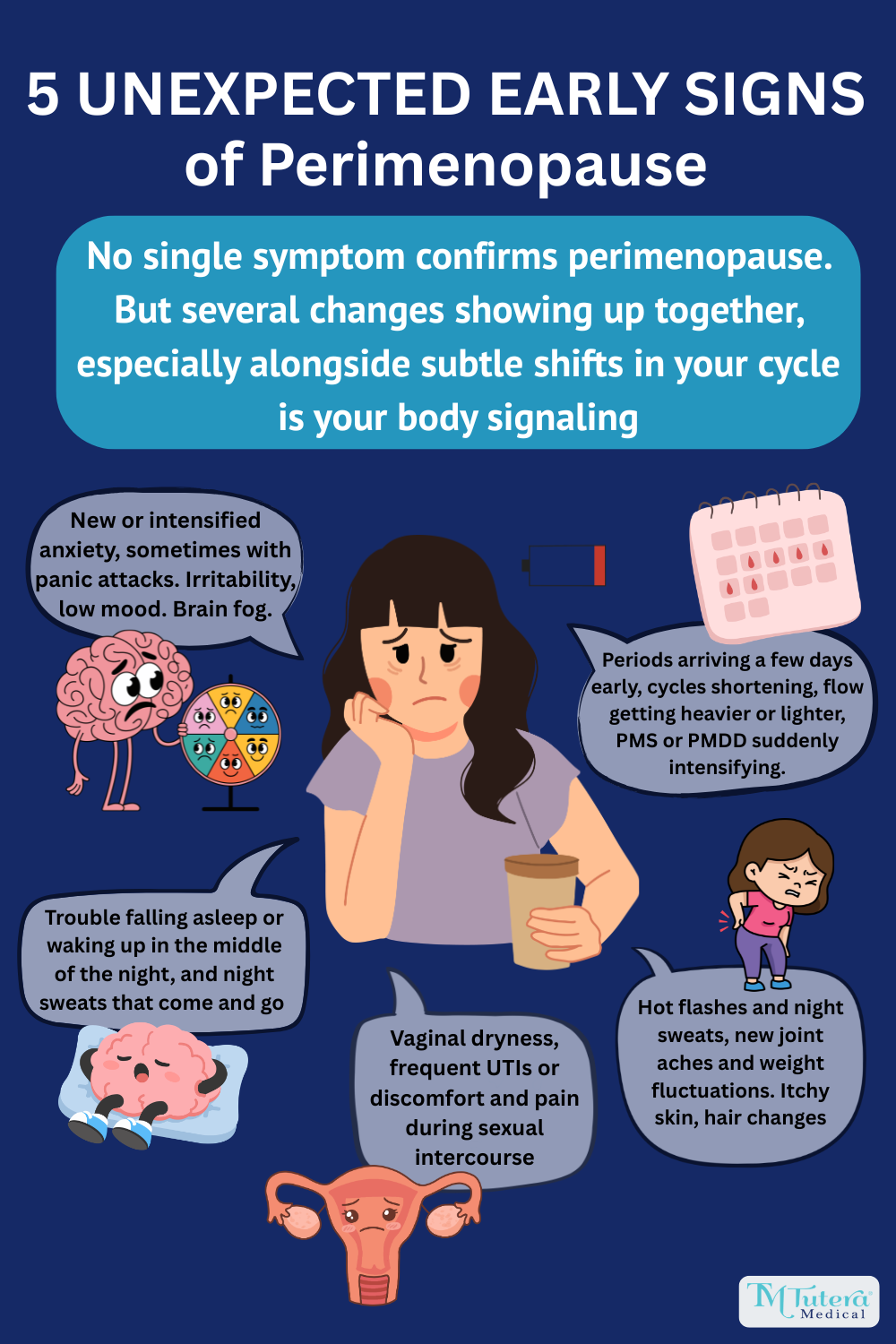
5 Unexpected early signs of perimenopause
No single symptom confirms perimenopause. What’s telling is several changes showing up together, especially alongside subtle shifts in your cycle. The common clusters:
Mood and mind. New or intensified anxiety, sometimes with panic attacks. Irritability that feels out of character. Low mood. Brain fog: losing words, forgetting details, struggling to focus at work. These consistently top the list of first symptoms women notice, and they’re also the most likely to be labeled as something else.
Sleep. Trouble falling asleep or waking up in the middle of the night, and night sweats that come and go caused by hormonal fluctuations.
Your cycle. Often the earliest objective clue, and often subtle: periods arriving a few days early, cycles shortening, flow getting heavier or lighter, PMS or PMDD suddenly intensifying. Later in the transition, cycles turn more irregular and eventually stretch far apart.
Your body. Hot flashes and night sweats, new joint aches or stiffness with no injury. Weight settling around the midsection despite unchanged dietary and exercise habits. Some experience itchy skin, hair and skin changes.
Vaginal. Vaginal dryness, frequent UTIs or discomfort and pain during sexual intercourse, often caused by fluctuating estrogen levels.
You don’t need to be experiencing all of these symptoms to be in perimenopause. You know your body best and if you start spotting signs, it is never too early to check in with a certified provider so you do not have to figure it out alone.
How to confirm when perimenopause starts?
The answer is it’s not straightforward and a simple blood test is not sufficient to determine the right answer. During perimenopause, estrogen and FSH don’t decline in a smooth, testable line. They fluctuate week to week, sometimes day to day. A single blood draw this week might show low hormone levels, but the same blood draw next week can show numbers in the normal range, which make it difficult to confirm.
However, bloodwork can be important and helpful in ruling out other conditions that can look like perimenopause such as thyroid problems, iron deficiency and anemia or blood sugar fluctuations and diabetes.
What treatment options do I have?
The good news is there are options to help you feel better based on your individual symptoms and this can look different for everyone.
Hormone therapy. One of the most common questions we hear is when to start HRT in perimenopause and the answer depends on your specific symptom picture and hormone levels. For the most common menopause symptoms like hot flashes, night sweats, vaginal and urinary issues, hormone therapy tend to be the most effective treatment. Many women also see meaningful improvement in sleep, mood stability, brain fog, and joint pain. In perimenopause specifically, options range from progesterone alone (often helpful for sleep and heavy or erratic cycles) to combined estrogen and progesterone, to low-dose vaginal estrogen for genitourinary symptoms with minimal absorption elsewhere.
However, HRT is also not for everyone. Your health history, unique symptoms and personal preferences all shape the decision. It is important to check in with a trained provider to come up with your tailored treatment plan.
Non-hormonal options. If hormones aren’t a fit or aren’t your preference, there are other alternatives. Certain antidepressants and other prescription medications can also reduce hot flashes and other symptoms that you can discuss with your certified provider.
The foundation. Depending on your current lifestyle habits, changing your current routines can also help tremendously with easing perimenopause symptoms such as having a good sleep routine with consistent timing, strength training at least twice a week (good for body composition, bone, and quality of life through the transition), building meals around protein and fiber to steady blood sugar and energy, and stress management.
How to prepare for your appointment
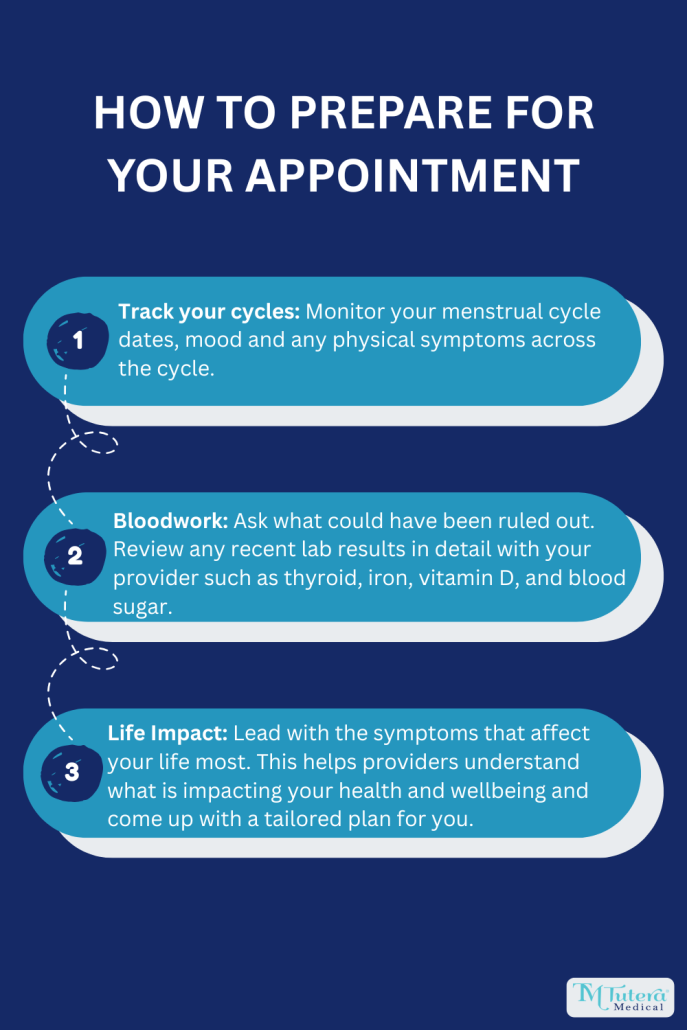
Come prepared with your health history including menstrual cycle patterns and list of symptoms and any other questions you might have.
- Track your cycles: Monitor your menstrual cycle dates, mood and any physical symptoms across the cycle.
- Ask what could have been ruled out from bloodwork: Review any recent lab results in detail with your provider such as thyroid, iron, vitamin D, and blood sugar.
- Lead with what affects your life most: This helps providers understand what is impacting your health and wellbeing the most and come up with a tailored plan for you.
Key takeaways
- So when does perimenopause start? For most women, perimenopause begins in their 40s but can start in the 30s, and age alone can never rule it out.
- The earliest signs can be very subtle which is why they often get mislabeled as stress or anxiety. No single blood test confirms or excludes it; the diagnosis is clinical, and labs mainly rule out look-alikes like thyroid disease and anemia.
- There are effective treatment options for everyone, with hormone therapy being the most effective option for many women and other alternatives for those who can’t or don’t want to use it.
- You don’t have to wait for a certain age to start seeking care
Frequently asked questions
What are the very first signs of perimenopause? Usually subtle cycle changes together with mood changes, brain fog, or sleep disruption. Hot flashes often come later, which is why the early phase is so frequently missed.
Can a blood test confirm perimenopause? No single test can because hormone levels fluctuate widely during perimenopause. The diagnosis depends on symptoms, cycle patterns, and age together. Labs are most useful for ruling out conditions that mimic perimenopause. However, a blood test can confirm menopause.
Am I too young for perimenopause? No, every woman goes through perimenopause at different stages. If you’re experiencing any symptoms, you should seek care.
Can you still get pregnant during perimenopause? Yes because ovulation still continues even though less predictably. If you want to avoid pregnancy, contraception is still needed until you are at menopause when you’ve gone through 12 consecutive months without a period.
Does HRT help with perimenopause symptoms or only after menopause? Hormone therapy is used during perimenopause as well, and specialty guidance supports it for symptomatic women in this window. The regimen differs from postmenopausal treatment and should be tailored to where you are in the transition.
This article is for education, not individual medical advice. Perimenopause overlaps with other conditions that deserve proper evaluation, and decisions about hormone therapy should be made with a qualified clinician who knows your full history.